

October 29, 2025
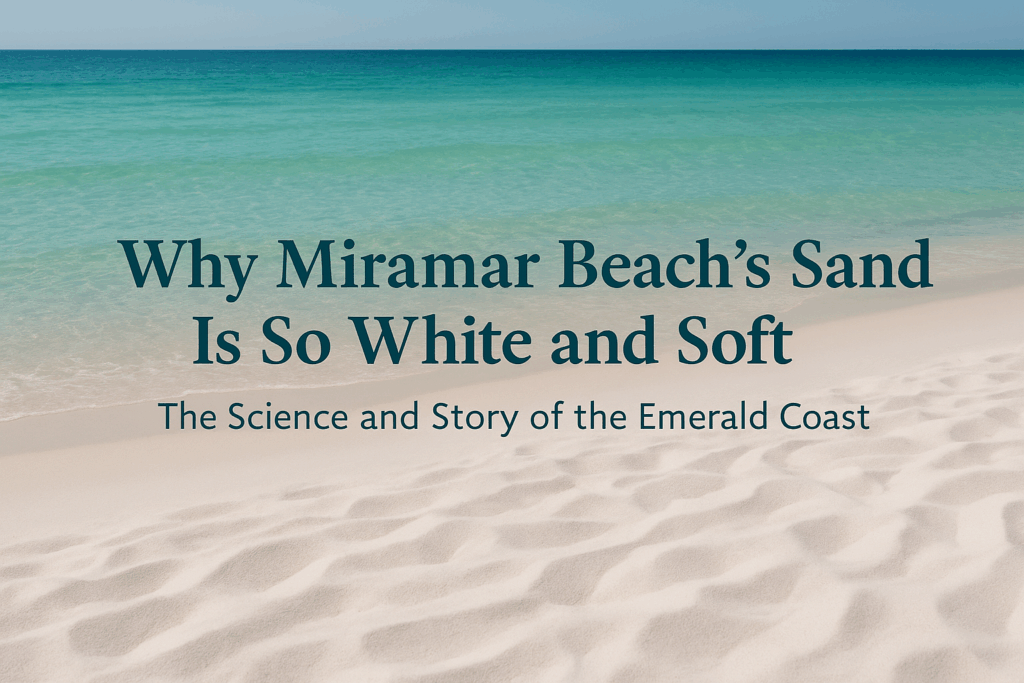
Why Miramar Beach’s Sand Is So White and Soft: The Science and Story of the Emerald Coast
Meta Title: Why Miramar Beach’s Sand Is So White – The Science of the Emerald Coast
Meta Description: Discover the true story behind Miramar Beach’s bright white sand — how ancient quartz from the Appalachians created one of the softest, whitest coastlines on Earth.
A Beach That Glows Like Snow
Visitors often describe their first steps onto Miramar Beach as a sensory shock — the sand looks almost unreal, glowing under the sun like crushed pearls. It’s soft, cool, and impossibly white, squeaking faintly underfoot. Locals smile when people ask, “Is it really that color, or is it just the light?”
It’s real — and it’s rare. Miramar Beach’s sand is among the purest quartz sand on the planet, formed by an ancient geological journey stretching back tens of thousands of years. This isn’t just a vacation backdrop; it’s a natural masterpiece shaped by rivers, time, and the quiet persistence of the Earth itself.
A Journey That Began in the Mountains
The story of Miramar Beach’s sand starts not at the shoreline, but deep in the Appalachian Mountains, hundreds of miles to the north. Over millions of years, rain, wind, and ice eroded those mountains — some of the oldest in the world — sending tiny particles of quartz cascading down rivers toward the Gulf of Mexico.
These rivers carried sediment through what is now Georgia and Alabama, finally depositing it into the Gulf. Lighter minerals like feldspar and mica broke down along the way, but quartz, being hard and resistant to weathering, endured.
By the time the particles reached Florida’s Panhandle, nearly everything else had been filtered out. What remained was pure crystalline quartz — a fine, snow-like sand that would eventually blanket Miramar Beach.
Why It’s So White
That dazzling whiteness comes from the high purity of the quartz grains — about 99.9% pure silica. Unlike darker sands, which mix with volcanic rock or shell fragments, Miramar’s sand is almost completely free of impurities. Each grain is translucent and highly reflective, scattering sunlight like tiny prisms.
This reflectivity also explains why the beach looks so bright in photos and even glows under moonlight. The grains act like natural light amplifiers, creating a visual effect closer to snow than sand.
It’s this same mineral makeup that gives the sand its distinct “squeak” when walked on — a phenomenon caused by friction between perfectly smooth, round quartz grains.
Why It Feels So Soft (and Cool)
Miramar Beach sand doesn’t just look special — it feels different too. The fine, uniform grains are polished smooth by centuries of water and wind movement. Because quartz has a high thermal resistance, the sand doesn’t absorb heat easily, staying cool underfoot even on the hottest summer days.
That’s why you can walk barefoot across Miramar Beach at noon without hopping around in pain — a small but magical detail that visitors never forget.
Nature’s Perfect Filter
Another side effect of this fine, pure quartz is water clarity. The tightly packed grains act like a natural filtration system, keeping sediment from clouding the surf. Combine that with the gentle slope of the Gulf floor and you get the emerald-green water that defines the entire Emerald Coast.
When sunlight hits the clear Gulf, it reflects off the white sand beneath the surface, creating that luminous blue-green glow. So in a way, the water’s famous color is really a reflection of the sand itself.
Where Else in the World You’ll Find It (Hint: Not Many Places)
Miramar Beach is part of a very short list of global coastlines with this level of sand purity. The only comparable examples are:
- The Whitest Beaches of Hyams Beach, Australia, often cited in world records.
- The Whitest Sands of the Gulf Islands National Seashore, stretching east from Miramar to Pensacola.
- Certain stretches of the Bahamas and Maldives, though their brightness comes from coral, not quartz.
The difference? Those are tropical sands born from coral or limestone. Miramar’s sand is continental in origin — older, rarer, and geologically distinct.
The Sand That Sings
If you’ve ever noticed the soft squeak or crunch when walking on dry patches of beach, you’ve heard what locals call “singing sand.” It’s not your imagination — the sound comes from the grains vibrating in unison.
Because the quartz is so round and clean, the grains can resonate like tiny bells when compressed underfoot. This phenomenon only happens when conditions are just right: dry, fine, and perfectly smooth sand — which Miramar Beach happens to have in abundance.
So yes, the beach literally sings when you walk on it.
A Fragile Beauty Worth Protecting
For all its purity, this sand is delicate. It’s constantly reshaped by tides, wind, and storms. Beach erosion, rising sea levels, and overdevelopment pose ongoing challenges to keeping it pristine.
Thankfully, local and state initiatives — like Walton County’s dune restoration and SWARA’s artificial reef projects — help stabilize the coastline and preserve natural habitats. Visitors can do their part too:
- Stay off dune vegetation (those plants anchor the sand).
- Pack out everything you bring in.
- Avoid using detergents or non-reef-safe sunscreens that can harm marine life.
Each footprint, each towel, each sandcastle matters more than most people realize. The beach is alive — not just with people, but with microorganisms, ghost crabs, and nesting sea turtles that depend on that flawless quartz terrain.
Why Locals Call It Home
For locals, Miramar’s white sand isn’t just scenery — it’s identity. Kids grow up playing in it, couples marry on it, and artists paint it endlessly. There’s even a quiet pride in its upkeep: beach cleanups are social events, and every storm recovery feels personal.
The sand connects everyone here. It’s the thread between science, memory, and emotion. That soft, white powder carries stories — from mountains eroded long ago to the people who now walk those ancient grains each day.
The Science in Simple Terms
For readers who like the short version, here’s the geological recipe for Miramar Beach:
- Source: Appalachian quartz rock eroded by rivers over millions of years.
- Transport: Carried south by the Apalachicola River and smaller streams.
- Purification: Softer minerals broke down; quartz survived.
- Deposition: Over time, waves and currents laid the quartz evenly along the Gulf Coast.
- Refinement: Wind and tides polished the grains into smooth, uniform spheres.
Result: a beach that looks painted, feels like powder, and glows like glass.
Cultural Lore and Local Legends
Over the decades, the sand has earned its own share of folklore. Some locals claim the brightness comes from “moon dust,” others from “frozen lightning.” Poets call it “Florida snow.”
Whatever version you believe, the sand inspires a reverence usually reserved for cathedrals or ancient ruins. It’s the thing people remember most — not the restaurants, not the condos, but the sensation of that flawless quartz under their toes.
There’s a reason photographers return again and again to capture it at golden hour. The sand doesn’t just reflect light; it transforms it.
What the Future Holds
Preserving Miramar Beach’s sand is an ongoing collaboration between nature and community. Local conservationists continue to monitor dune health, beach renourishment, and erosion rates, ensuring future generations can experience the same white-sand wonder.
In 2026 and beyond, expect to see more eco-education at beach accesses — QR codes linking to reef maps, sand science facts, and visitor pledges to keep the coast clean. It’s all part of a larger movement to protect what makes the Emerald Coast unique.
Because once you understand the sand, you can’t take it for granted.
Frequently Asked Questions
Q: What makes Miramar Beach’s sand so white?
A: It’s made almost entirely of pure quartz crystals washed down from the Appalachian Mountains and refined by thousands of years of Gulf currents.
Q: Why does the sand squeak when you walk on it?
A: The smooth, round quartz grains rub together in dry conditions, creating a subtle squeak — known as “singing sand.”
Q: Does the sand get hot in the sun?
A: Not much. Quartz reflects heat, so Miramar Beach sand stays surprisingly cool even on hot summer days.
Q: Why is the water so clear and green?
A: The pure white sand reflects sunlight through shallow, clean water, giving the Gulf its famous emerald color.
Q: How can visitors help protect the sand?
A: Use designated walkovers, avoid disturbing dunes, and leave nothing behind. Small actions keep the coast pristine.