

October 29, 2025
The End of a Quiet, Miraculous Season
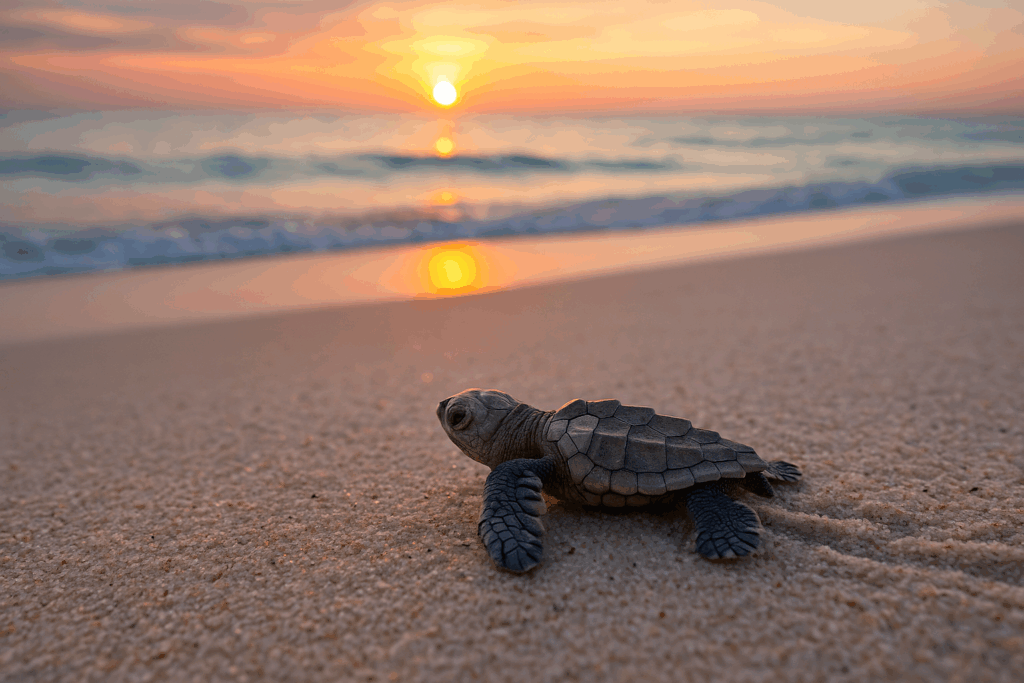
As the final traces of summer slipped from the Gulf and the last waves of tourists rolled home, Miramar Beach entered one of its most peaceful moments of the year. The sand was marked not by beach chairs and coolers, but by the faint tracks of hatchlings — hundreds of tiny, determined lines leading back to the sea.
The 2025 sea turtle nesting season, which officially ran from May through October, has now drawn to a close. Local conservation groups and volunteers across South Walton are celebrating what they call one of the most successful and stable nesting periods in years.
In an area where human activity, storms, and light pollution have long challenged the survival of endangered turtles, the 2025 season offered something rare: balance.
A Record Season for Loggerheads
Preliminary data from the South Walton Turtle Watch Group suggests that Miramar Beach recorded over 90 nests this year, the majority belonging to loggerhead turtles (Caretta caretta) — the Gulf Coast’s most common nester. Several green sea turtle nests were also documented, along with rare appearances from Kemp’s ridley and leatherback turtles.
It was a season of resilience. Despite heavy summer storms and fluctuating Gulf temperatures, the majority of nests survived to hatch. Volunteers reported strong hatchling emergence rates, particularly in late August and September.
“This year proved that long-term conservation efforts are working,” one local coordinator noted. “We saw cleaner beaches, fewer lighting violations, and more community awareness than ever before.”
Miramar Beach’s Role in a Bigger Story
Miramar Beach isn’t just a stopover for sea turtles — it’s a critical part of the northern Gulf’s nesting corridor. From Panama City Beach to Destin, these coastal habitats form a chain of potential nesting sites, each one essential to the species’ recovery.
Loggerhead turtles return to the same stretch of beach where they were born, guided by the magnetic imprint of the coastline. Every hatchling that survives adds another link to that chain.
This makes Miramar Beach’s continued stewardship not just a local concern, but a global one. Sea turtles are migratory, traveling thousands of miles across the Atlantic before returning home decades later. What happens on this beach influences the species’ survival worldwide.
Human Habits, Natural Consequences
If 2025 had a theme, it was awareness through action. Walton County has strengthened its beach regulations, enforcing stricter lighting ordinances and expanding educational signage at public accesses. Hotels and homeowners along Scenic Highway 98 swapped harsh white lights for amber LEDs.
Visitors, too, played their part. Social media campaigns emphasizing “Clean, Dark, Flat” — the mantra of turtle protection — helped change nightly behavior on the sand. More people learned to pack up their gear, fill in holes, and avoid flash photography after sunset.
The result? Fewer disoriented hatchlings, fewer nest disturbances, and a smoother migration to the sea.
When the Moon Guides the Way
Watching a hatchling emerge is one of the most humbling sights on the Gulf Coast. Under a starlit sky, the sand ripples, tiny heads appear, and dozens of turtles instinctively turn toward the glimmer of the horizon. They follow the moon’s reflection on the water, an evolutionary compass developed over 100 million years.
But this delicate system depends on natural darkness. Even a single porch light or a bright phone screen can mislead them inland. In 2025, volunteers documented a notable decline in disorientation incidents compared to previous years — a sign that educational outreach and compliance are finally working.
Weathering the Storms
Hurricane season always overlaps with turtle nesting season, creating a yearly gamble between nature’s cycles. This year, several tropical systems brushed the Panhandle, but only one — Hurricane Francine in late August — caused measurable nest loss.
Thanks to early relocation efforts and strategic dune protection, most vulnerable nests were moved before storm surge arrived. These efforts preserved hundreds of hatchlings that might otherwise have been swept away.
It’s another example of how proactive local management — not luck — keeps populations stable.
Tourism, Education, and Eco-Identity
The 2025 season also strengthened Miramar Beach’s growing identity as an eco-tourism destination. Visitors didn’t just come for the sand; they came to understand it. Guided turtle talks, educational signage, and kid-friendly volunteer programs have turned conservation into part of the vacation experience.
This blend of tourism and stewardship aligns with a broader Gulf Coast trend: travelers seeking meaningful interaction with nature rather than passive consumption of it.
From an SEO and storytelling perspective, it’s an opportunity for Miramar Beach to brand itself as “The Beach That Protects Its Own.”
Challenges That Remain
Despite the progress, threats persist. Artificial lighting violations, unattended beach furniture, and vehicle activity on the sand continue to endanger nests. Plastic debris — even small fragments — can entangle hatchlings or be mistaken for food by juveniles offshore.
The South Walton Turtle Watch Group plans to increase monitoring in 2026, expanding public outreach into early spring to catch visitors before the season begins.
“Education is our first defense,” a volunteer coordinator said. “Most people don’t mean to harm the turtles — they just don’t know how easy it is to make a difference.”
Looking Ahead to 2026
As planning begins for the 2026 nesting season, conservationists are optimistic. New monitoring equipment, including infrared cameras and GPS-tagging initiatives, will help scientists study migration routes and identify problem zones for disorientation.
The community is also exploring ways to integrate turtle protection with smart tourism — offering eco-certifications for beachfront rentals and businesses that comply with lighting standards and participate in cleanup efforts.
If successful, Miramar Beach could become a model for sustainable coastal tourism: a destination that balances growth with guardianship.
How Visitors Can Help Next Season
Visitors play a direct role in the survival of these ancient mariners. Whether staying for a week or a weekend, a few simple steps make all the difference:
- Stay Dark: Use amber-filtered flashlights or apps with red-light filters if walking at night.
- Stay Clean: Remove everything from the beach after sunset — even small toys and towels.
- Stay Flat: Fill in holes and smooth over sandcastles before leaving.
- Stay Informed: Look for posted turtle-nesting signs and respect protective tape and stakes.
Local organizations like the South Walton Turtle Watch Group often post updates and volunteer opportunities on social media each spring. Getting involved — even for a morning — turns awareness into action.
Why It Matters
Sea turtles are among the oldest living species on Earth, surviving when dinosaurs did not. Every nest on Miramar Beach carries that legacy forward.
Their story is one of resilience and interdependence — between ocean and sand, storm and sun, human and habitat. The more Miramar Beach grows, the more essential it becomes to remember that harmony is what keeps both the community and the coastline alive.
The 2025 season proved that coexistence is possible. The 2026 season will test whether we can sustain it.
Frequently Asked Questions
Q: When does sea turtle nesting season occur in Miramar Beach?
A: The season runs annually from May 1 through October 31. During this time, nesting females come ashore at night and hatchlings emerge roughly two months later.
Q: What species of sea turtles nest here?
A: Primarily loggerheads, but green, Kemp’s ridley, and occasional leatherbacks also nest in the area.
Q: Can I see the turtles?
A: Sea turtles are protected under federal law. Visitors may not touch or approach nesting females or hatchlings, but some guided educational programs are available through local organizations.
Q: How can I help protect sea turtles during my stay?
A: Follow the “Clean, Dark, Flat” principles, avoid bright lights, and remove obstacles from the sand at night.
Q: Are there volunteer opportunities?
A: Yes. The South Walton Turtle Watch Group and Choctawhatchee Basin Alliance both welcome seasonal volunteers for nest monitoring and beach cleanup.